
When I started building Tellr, I had a fairly simple idea: social media is public, but the things that matter most to us often aren't.
Family photos. Stories about people we love. A recording of your grandmother telling a story you've heard a hundred times. A letter to your child that you hope they'll keep forever.
Building a place for those things is one challenge. Building a place where people feel comfortable putting them is another.
I've spent much of my career in cybersecurity, so I probably think about this stuff more than the average person. Occupational hazard. But it also means I know how easily security becomes an afterthought when someone is excited about getting a product out the door.
With Tellr, I wanted to approach it differently. Not by adding an impressive-looking padlock to the homepage and calling it secure. By making privacy and security part of how the product actually works.
Private should actually mean private.
Most online platforms are designed to encourage sharing. More followers, more engagement, more visibility.
Tellr starts with a different assumption: what you create belongs to you, and you decide who gets to see it.
There's no public feed of your family's memories. People don't automatically gain access because they're tagged in a photo or mentioned in a story. Being part of someone's life and being allowed to see their private content are two very different things.
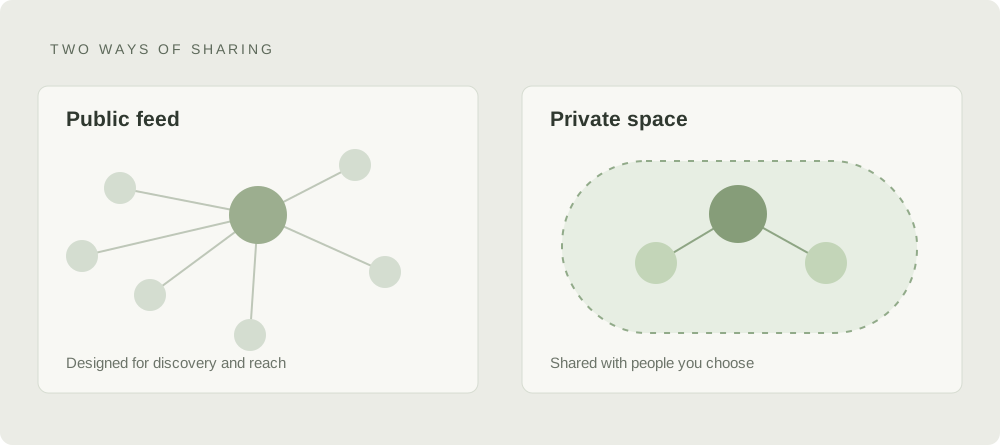
That's also why Tellr checks whether someone is actually allowed to access something. Finding a link doesn't automatically mean you have permission.
A link is an address. It isn't an invitation.
Your memories aren't an advertising opportunity.
There's another part of privacy that I think gets overlooked. What happens to your information after you've shared it with a platform?
We've become pretty accustomed to social media companies collecting enormous amounts of information about us and using it to power their advertising businesses.
Meta has built an extraordinarily successful business around targeted advertising. Good for them, I suppose. But I don't particularly love the idea of my personal life becoming someone else's marketing data.
Tellr works differently.
We don't sell your personal information to advertisers. We don't run ads. And we don't build advertising profiles based on your memories, relationships, or conversations.
If you upload a photo of your family vacation, it's there because you wanted to preserve that memory. Not because someone needs to figure out whether you'd be interested in buying another suitcase.
It's a fairly straightforward philosophy. Your memories are yours. They're not inventory for an advertising business.
And I'd like to keep it that way.
Sharing something shouldn't mean sharing it with everyone.
One of my favourite things about Tellr is the ability to create a space for the people who matter to you.
Maybe it's a collection of family photos. Maybe it's a recording of someone telling a story. Or maybe it's a message for your daughter to open on her eighteenth birthday.
Those are all things worth keeping. But they're not necessarily things you want everyone seeing.
Imagine you create a family space and invite a few people. You might want everyone to see the vacation photos, but only your partner to read a particular message. You might record something for your child today but want them to receive it years from now.
Tellr is designed to respect those choices. Access isn't assumed just because someone is part of a shared space, and the people mentioned in memories don't automatically get access to them.
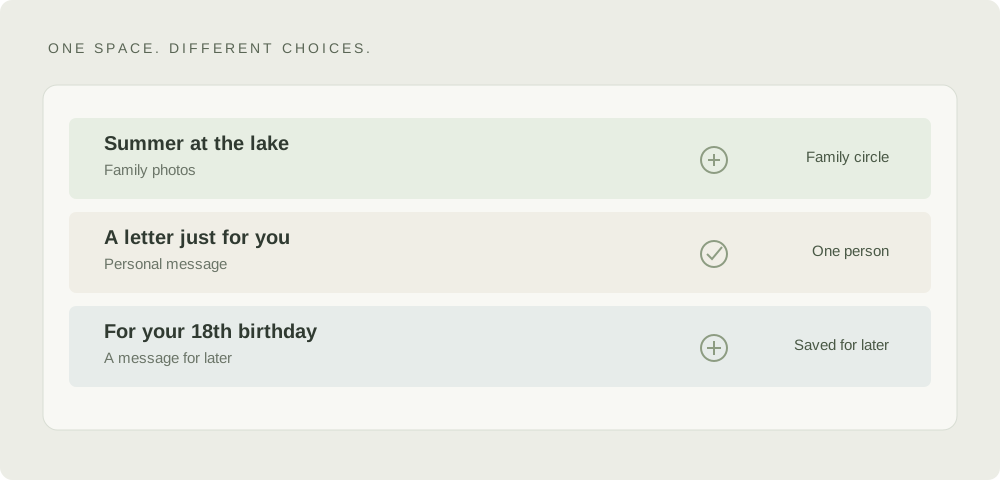
Knowing someone exists isn't the same thing as having permission to see their memories.
The goal isn't to make people think about security every time they share something. Quite the opposite. It's to let them enjoy the experience, knowing the privacy choices they make are respected.
Encryption, without the marketing nonsense.
You'll see the word encrypted on just about every technology product these days. It's important, but it's also remarkably easy to put on a marketing page without explaining what it means.
Imagine putting a letter in a locked box. Someone might see the box sitting on a shelf, but that doesn't mean they can read what's inside.
Encryption works on a similar principle. It transforms readable information into something that requires the appropriate cryptographic key to make sense of it.
Tellr uses encryption to protect sensitive information in storage and protects information as it travels between your device and the service.
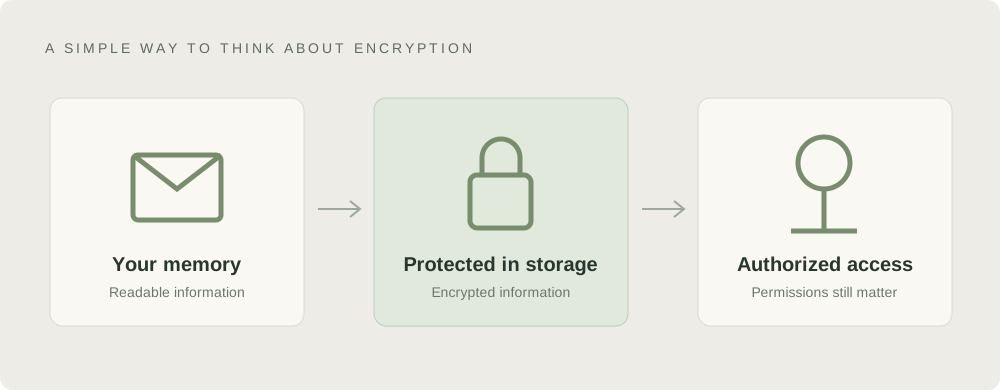
There's an important distinction here: encryption doesn't magically make a system immune to attackers. And encrypted storage isn't the same thing as end-to-end encryption, where only the participants hold the keys.
Security comes from combining protections, not relying on one impressive-sounding technology and hoping for the best.
Your account is more than a password.
Passwords have been part of the internet for decades, and they've given us decades of reasons to be suspicious of them.
People reuse them. They get stolen. They turn up in breaches. And occasionally someone decides Password123! is an inspired choice. I'm more partial to: CorrectHorseBatteryStaple myself.
Tellr supports passkeys, which let you sign in using familiar device authentication, such as your fingerprint, face, or device PIN.
One thing I like about passkeys is that they make security simpler for the person using the product. They're also designed to resist phishing, because they work with the legitimate website rather than a convincing imitation.
Passwords are still supported. But passkeys are the direction I'd encourage people to take.
The best security features are often the ones you barely notice.
Some things deserve an extra check.
There's a difference between a photograph from a family barbecue and a document containing especially personal information. Both deserve privacy, but the consequences of exposing them can be very different.
Tellr's Vault is intended for the things you want to take particular care with. Sensitive activities can require you to confirm it's really you, even when you're already signed in.
It's a bit like your bank asking you to verify yourself again before making an important change. Being signed in doesn't mean every action should be treated exactly the same.
Security isn't a feature you finish.
There's a tendency in technology to talk about security as though it's a destination. Build the product. Run some tests. Put up a security page. Done.
Unfortunately, that's not how it works.
Software changes. New vulnerabilities are discovered. Attackers find new techniques. And features that seem harmless on their own can create unexpected problems when combined.
Tellr includes automated testing for important security-sensitive behaviours. That's useful, but it's only one part of maintaining a secure product.
I don't believe in telling people a website is completely secure. Anyone making that promise is either oversimplifying things or has a rather optimistic understanding of how software works.
What I can say is that I made security a design priority for Tellr, not something to revisit after people start trusting it with their memories. And that work needs to continue as the product grows.
The whole point is trust.
I didn't build Tellr because the world needed another place to upload photographs. We already have plenty of those.
I built it because I think there's room for something more personal. A place where you can preserve a voice, tell a story, leave a message, or share something meaningful without turning it into content for a public feed.
But that only works if people feel comfortable putting those things there.
The security behind Tellr is meant to support that experience, not become the experience itself.
Because if someone trusts Tellr with a message for their child, a photograph they treasure, or a story they aren't ready to share with the world, that's a responsibility worth taking seriously.
Some things are worth keeping. And some things are worth protecting.
A private place for memories, messages, and the people who matter to you.
Tellr is a product I've built independently. This article describes the thinking behind its security and privacy design, not a guarantee against every threat or an independent security certification. For the product's public explanation of safeguards, visit Tellr Safeguards.